
For each year since 1936, Michelin has updated its guidebooks to award or deduct up to 3 stars for each restaurant it inspects. The inspection process is shrouded in secrecy to avoid conflicts of interest and stars are scarcely awarded. The stars have since become one of the most recognized and respected awards a restaurant can achieve, with thousands of chefs from all corners of the globe devoting their lives to the pursuit of just a single star.
In fact, Michelin-starred cooks take the stars so seriously that renowned chefs, such as Gordon Ramsay, have wept over the loss of one or more stars, with some even taking their own lives.
“I started crying when I lost my stars. It's a very emotional thing for any chef. It's like losing a girlfriend. You want her back. I think every top chef in the world, from Alain Ducasse to Guy Savoy, when you lose a star it's like losing the Champions League.”
A single star can have customers flocking to that designated restaurant, bringing about both immense amounts of money and fame. The late and great Joël Robuchon, who himself had accumulated a record 32 Michelin stars, once said that “with one Michelin star, you get about 20 percent more business. Two stars, you do about 40 percent more business, and with three stars, you’ll do about 100 percent more business.”
Customers and investors alike are therefore very keen to predict which restaurants eventually earn a Michelin star before the competition gets fierce.
In the current Michelin-covered export, the imbalance is stark: 61,030 restaurants are treated as No Star after combining Not in Guide, Selected, and Bib Gourmand statuses, compared with 2,711 one-star restaurants, 474 two-star restaurants, and just 138 three-star restaurants.
That makes correctly identifying a restaurant with a star so difficult that a standard ML model would probably be worse off than a basic line of code that constantly outputs a negative Michelin classification. Our model has to find rare signal without turning every expensive, highly rated restaurant into a fake three-star prediction.
Our currently published Project Three Star Model is the v2 star-tier classifier. The numbers in this section are a current-label audit of the Michelin-covered public export, not held-out validation. On that audit, v2 reaches a 97.97% exact-tier match rate and 73.35% pooled Macro F1 across the four public tiers. Accuracy is reported for context only; an always-No-Star baseline would score 94.84% accuracy on this same covered export, but only 24.34% Macro F1 because it never recovers a starred restaurant.
| Predicted No Star | Predicted 1 Star | Predicted 2 Stars | Predicted 3 Stars | |
|---|---|---|---|---|
| Actual No Star | 60,581correct no-star calls | 306called 1 Star | 46called 2 Stars | 97called 3 Stars |
| Actual 1 Star | 397missed as No Star | 1,934correct 1-star calls | 134called 2 Stars | 246called 3 Stars |
| Actual 2 Stars | 17missed as No Star | 12called 1 Star | 404correct 2-star calls | 41called 3 Stars |
| Actual 3 Stars | 7missed as No Star | 0called 1 Star | 1called 2 Stars | 130correct 3-star calls |
The matrix above shows the new tradeoff directly: v2 keeps the No Star gate far tighter than v1 while still recovering 87.33% of known starred restaurants. The remaining weakness is exact 3 Star precision: the model is intentionally willing to surface some ambitious 3 Star candidates, so the star/no-star decision is still best judged with recall, precision, and Macro F1 rather than accuracy alone.
The v1 public rule was built to recover nearly every known starred restaurant. It did that, but it over-published starred predictions: 8,216 rows in the Michelin-covered export were called starred, and 5,080 of those were currently unstarred. The v2 model is more selective. It cuts false starred calls to 449 while still recovering 2,902 of the 3,323 known starred restaurants in the covered export.
| Metric | v1 model | v2 model | Change |
|---|---|---|---|
| Exact-tier match | 91.22% | 97.97% | +6.75 points |
| Macro F1 | 67.05% | 73.35% | +6.30 points |
| Starred precision | 38.17% | 86.60% | +48.43 points |
| Starred recall | 94.37% | 87.33% | -7.04 points |
| Starred predictions | 8,216 | 3,351 | 4,865 fewer |
| False starred calls | 5,080 | 449 | 91.2% fewer |
In practice, v2 has more usable ranking power for readers. Its starred list is smaller, cleaner, and more plausible: starred precision rises from 38.17% to 86.60%, while starred recall remains high at 87.33%. That makes the public prediction table less of a broad discovery net and more of a sharper watchlist for restaurants that deserve serious attention.
Before choosing the public star-tier setup, we compared raw class probabilities, sigmoid-calibrated variants, class-offset tuning, and a weighted Project Three Star Model + LightGBM + XGBoost probability ensemble. The v2 release keeps the same discipline: probability quality is tested with grouped validation, while the public export is audited separately against current Michelin labels.
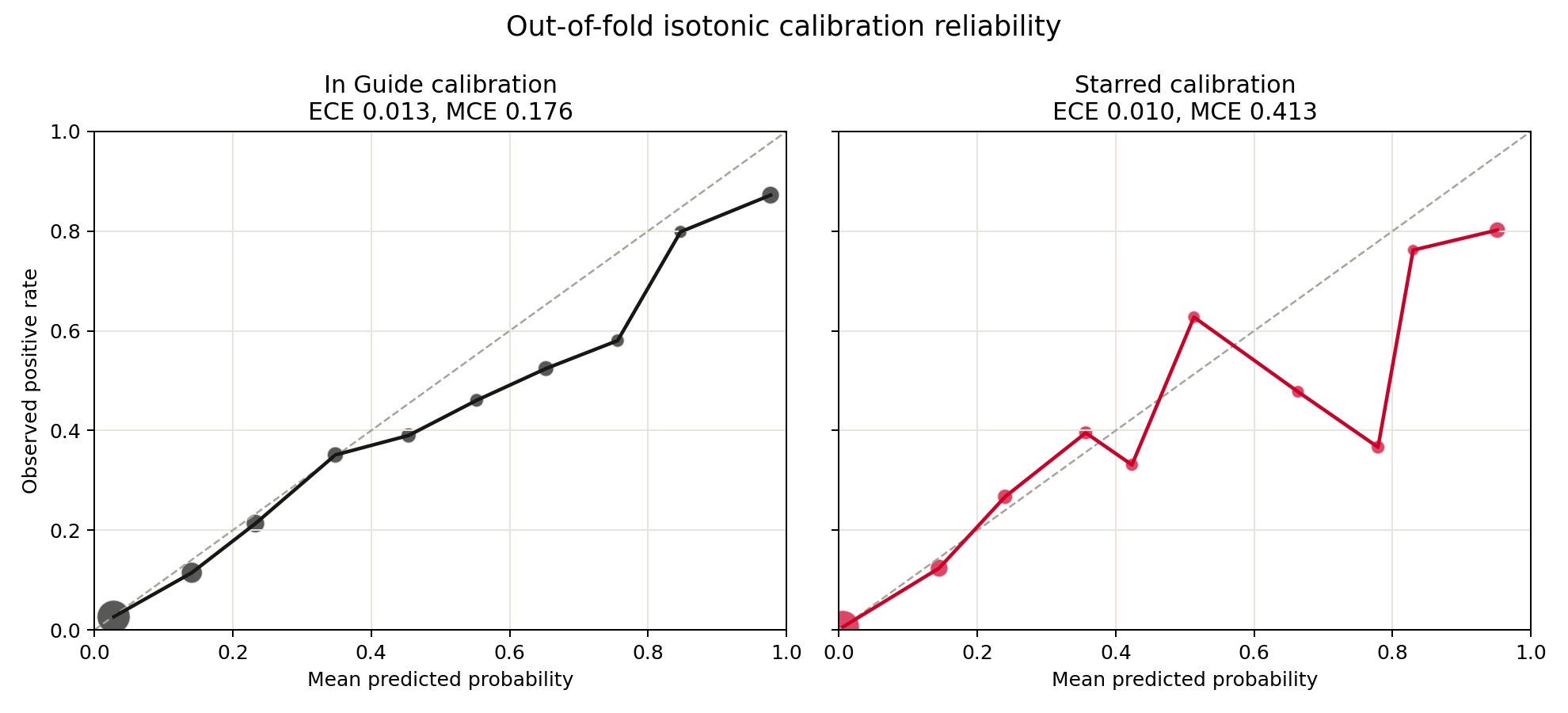
We used probability diagnostics to check whether higher scores actually corresponded to higher hit rates before choosing our public exact-tier model.
LightGBM and the weighted ensemble were useful probability references, but the v2 release was chosen only after grouped validation showed enough probability quality to rank rare starred outcomes without flooding the public table with false positives.
Our public exact-tier label comes from the audited prediction export, with v2 probabilities carrying both the No Star gate and the final star-tier choice. We still audit the public export separately because current-label performance and held-out ranking power answer different questions.
These are the highest-confidence restaurants that are currently unstarred inside Michelin-covered target cities and projected by our model to win 1 Star. They are not presented as next-cycle guarantees; they are the restaurants the Project Three Star Model most strongly believes deserve a closer look.
| Rank | Restaurant | City | Current status | Prediction | Confidence |
|---|---|---|---|---|---|
| 1 | Bistrot Marloe | Paris | Selected Restaurants | 1 Star | 95% |
| 2 | Cosme | New York | Selected Restaurants | 1 Star | 95% |
| 3 | Le B | New York | Selected Restaurants | 1 Star | 95% |
| 4 | Le 39V | Paris | Selected Restaurants | 1 Star | 95% |
| 5 | Upstairs (at Trinity) | London | Bib Gourmand | 1 Star | 95% |
| 6 | Monsieur Bleu | Paris | Selected Restaurants | 1 Star | 95% |
| 7 | Tram-Tram | Barcelona | Selected Restaurants | 1 Star | 94% |
| 8 | Gemellus | Paris | Selected Restaurants | 1 Star | 94% |
| 9 | Alteño | Denver | Selected Restaurants | 1 Star | 94% |
| 10 | Ovillo | Madrid | Selected Restaurants | 1 Star | 94% |
The research list above stays inside Michelin reporting coverage. The full prediction table also includes current Michelin-starred restaurants, guide candidates, projected 2 and 3 Star outcomes, supplemental non-covered markets, and lower-confidence rows.
View full prediction table